

Let’s be honest: math homework can be a struggle for everyone involved. Before the groans and flashcard fatigue set in, what if you had a secret weapon that your kids would actually ask for? That dusty deck of cards tucked away in a drawer is your answer, capable of transforming repetitive drills into a game they’ll genuinely enjoy. Check out qqdewa to know more
Unlike rote memorization, which often feels like a chore, simple card games create a low-pressure environment where learning happens almost by accident. Many educators have found that when children are engaged in play, they build a deeper, more intuitive understanding of numbers without the fear of getting the “wrong answer.” This is the key to making math fun for elementary students and building their confidence from the ground up.
This guide is a full toolkit of math activities with a deck of cards, turning you into a game-night hero. It starts with a simple twist on the classic game of War to practice addition, then moves on to games that secretly teach multiplication, comparison, and even the foundations of place value. Each one comes with step-by-step instructions that you can learn in minutes.
You don’t need expensive workbooks or another app subscription. All you need is one common household item to unlock hours of effective, screen-free math practice ideas. So grab that deck, and get ready to deal out a new, more joyful way to learn.
Why Cards Crush Flashcards: The Hidden Power of Playful Practice
For many kids, flashcards feel like a pop quiz. The pressure is on, and a wrong answer can feel like a failure. Card games flip that script entirely. By wrapping math practice in the fun of a game, you shift the goal from “getting it right” to simply “playing.” The element of luck in drawing a card means anyone can win a round, which lowers the stakes and keeps kids with math anxiety engaged and smiling.
This playful approach also builds something flashcards can’t: number sense. This isn’t about memorizing facts; it’s about developing an intuition for how numbers work together. When a child sees they have a 7 and their opponent has a 9, they aren’t just reciting facts—they’re instantly comparing values and understanding relationships. They begin to feel that a 7 and a 3 make 10, or that 12 is much bigger than 5. This intuitive grasp is the foundation for all future math success.
Ultimately, the goal is to get more practice time without the struggle. While flashcards offer repetition, card games offer repetition plus strategy, fun, and connection. Kids who are happy to play are kids who are learning without even realizing it. They’re building confidence one hand at a time, turning “I can’t” into “let’s play again!”
The Perfect First Game: Master “Addition War” in 2 Minutes
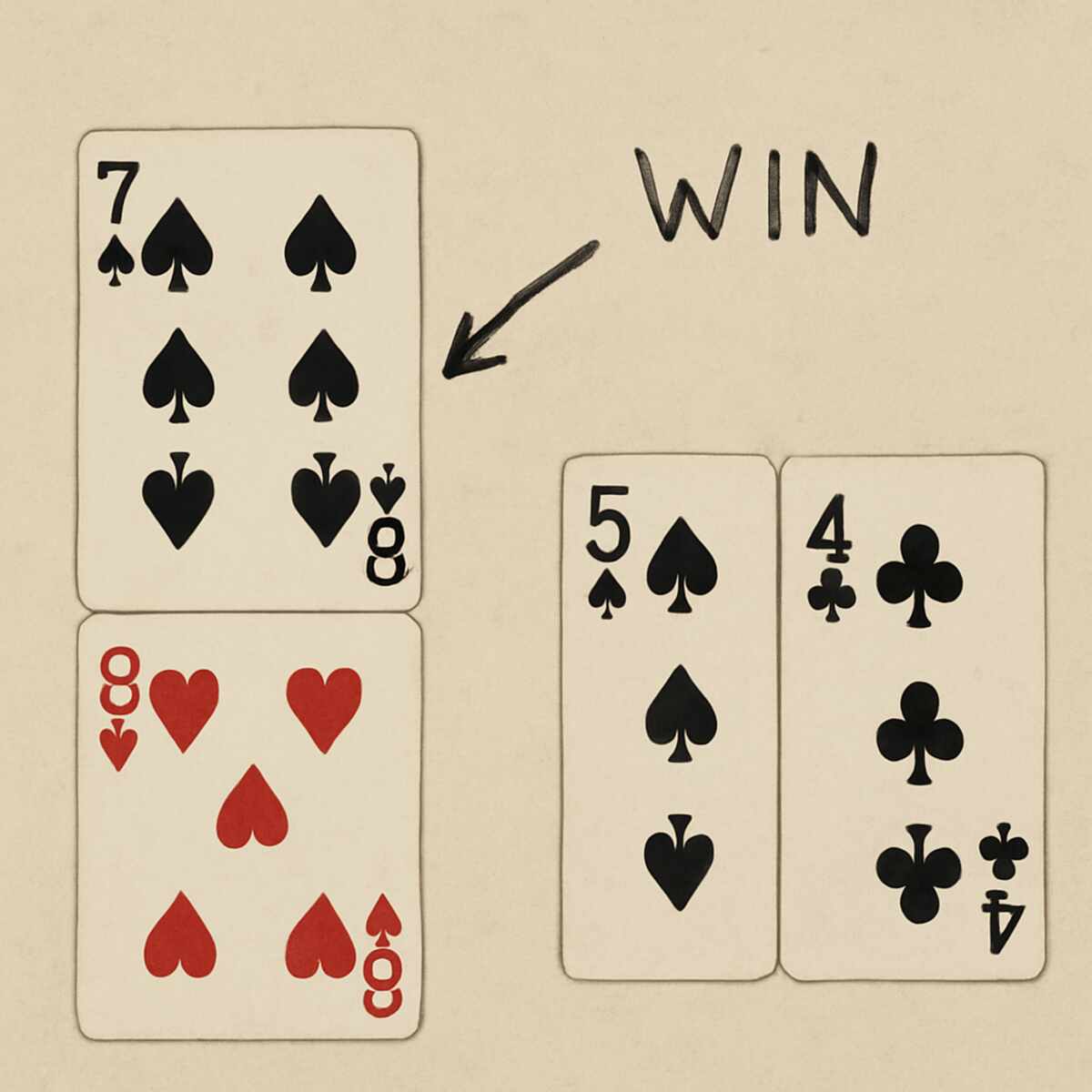
Ready for the easiest math card game on the planet? If you know the classic card game War, you’re already 90% of the way there. We’re just adding a simple math twist that transforms it into powerful addition practice. This game is a favorite with teachers and parents because it’s fast, fun, and kids learn the rules in a single round.
First, a quick rule for face cards to make them work for math: an Ace is 1, a Jack is 11, a Queen is 12, and a King is 13. Now, here’s how to play:
- Deal the Deck: Shuffle and deal all cards evenly between two players, face down.
- Flip Two: On the count of three, both players flip two cards face up.
- Add Them Up: Each player adds their two cards together to get a total.
- Highest Sum Wins: The player with the higher total wins the round and collects all four cards.
But what happens if you both get the same total? That’s when you declare a “War”! Each player places one card face-down, then flips a final card face-up. Whoever’s final card is higher wins the entire pile from that round. It’s a simple, exciting way to practice dozens of addition facts without it ever feeling like a drill.
How to Level Up “War”: From Subtraction to Multiplication
Once “Addition War” becomes second nature, you can easily tweak the rules to target other skills. The beauty of this game is its flexibility. If your child is working on subtraction, simply change one rule: instead of adding the two cards, subtract the smaller number from the larger one. The player with the highest answer still wins the round. This simple switch keeps the game familiar and exciting while providing crucial practice with subtraction facts, turning a potentially tricky concept into a friendly competition.
For a bigger challenge, especially for kids grappling with their times tables, you can introduce “Multiplication War.” This version is the ultimate secret weapon for parents wondering how to teach multiplication with cards. The rules are the same—each player flips two cards—but this time, they multiply them together. To keep the numbers manageable at first, you might decide to play with only the number cards (2-10). Suddenly, practicing 7×8 isn’t a dreaded worksheet problem; it’s the move that could win you the whole war!
Knowing which version to play is the key. These quick-start math fluency games for home can be perfectly matched to your child’s current lessons. Is their homework full of plus signs? Stick with Addition War. Are they learning “take-aways”? Switch to Subtraction War for the week. This adaptable approach keeps practice targeted and engaging.
What Is the “Make 10” Game and How Does It Build Number Fluency?
While the “War” games are great for quick-fire answers, some of the best math fluency games for home build a different skill: seeing how numbers fit together. A perfect example is a simple twist on the classic “Memory” game, which we’ll call “Make 10.” To play, just remove the face cards from a standard deck, shuffle the remaining cards (using Aces as 1), and lay them face down in a grid. Players take turns flipping over two cards. If the cards add up to 10, they keep the pair! If not, they flip them back over, and everyone tries to remember where they are.
This simple game does something incredibly powerful: it automatically teaches “number bonds.” That’s just a friendly term for pairs of numbers that make a key number, like 10. When a child instinctively knows that a 7 needs a 3, or an 8 needs a 2, mental math becomes dramatically faster. Adding a number like 27 + 3 becomes instant because they see the 7 and 3 make a new ten, turning the problem into an easy 20 + 10. This is one of the most effective addition card games for building true number sense, not just rote memorization.
Once your child has mastered finding pairs that make 10, the fun doesn’t have to stop. You can easily raise the stakes by changing the target. Why not play “Make 12” or “Make 15”? This simple adjustment keeps the game feeling fresh and encourages more complex thinking, pushing them to look for combinations like 8 and 4 or 9 and 6. This flexibility is what makes it one of the best number recognition games with a standard deck—it adapts as your child grows.
How to Visualize Numbers with the “Place Value Challenge”
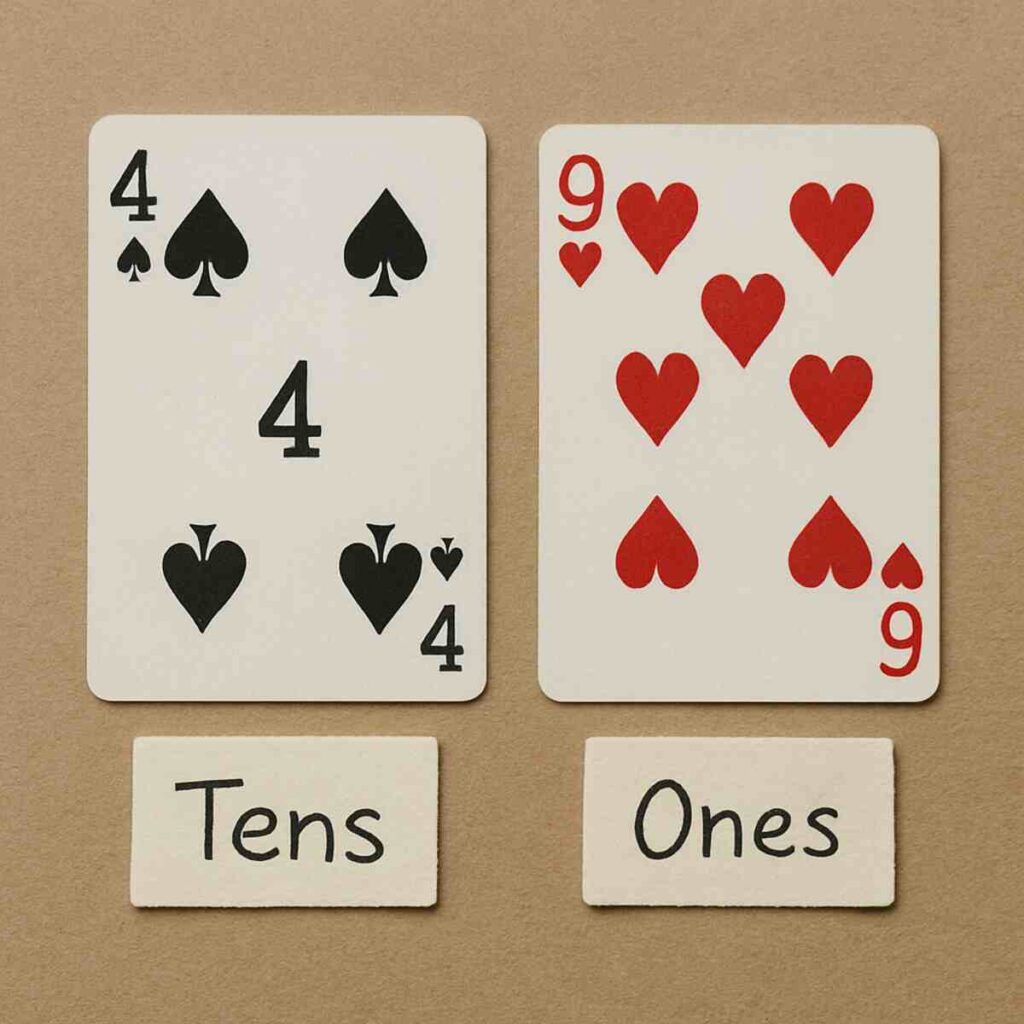
This next game introduces a concept called “place value”—which is just a fancy way of saying that in the number 52, the 5 is really “fifty,” not just five. The position of a card becomes just as important as its value. To see this in action, have your child create two spaces on the table: a “Tens” spot on the left and a “Ones” spot on the right. If they draw a 4 and a 9, they can physically place them to see the difference between the number 49 and the much larger 94. This simple act turns an abstract rule into something they can touch and control.
Now, let’s turn this into a game. In the “Place Value Challenge,” each player gets their own Tens and Ones spots. You’ll take turns drawing one card at a time from a shared pile and must immediately decide where to place it. If you draw a 7, do you lock it into your Tens spot for a guaranteed 70-something, or risk it in the Ones spot, hoping for a 9 to appear next? Once a card is placed, it’s stuck! The player who creates the bigger number at the end wins the round. It’s one of the most engaging educational games with playing cards for building number strategy.
This simple competition brilliantly demonstrates that a 3 in the Tens place is more powerful than a 9 in the Ones place. As they get comfortable, you can easily scale the fun by adding a “Hundreds” or even “Thousands” spot, making it a fantastic screen-free math practice idea that grows with them.
The Best Math Card Game to Play by Yourself: “Pyramid 13”
While competitive games are fantastic for pairs, sometimes you need an engaging activity a child can do on their own. Enter “Pyramid 13,” a classic solo challenge that feels more like a puzzle than a math problem. It’s one of the best single-player math card games because it rewards patience and planning, making it a perfect screen-free activity for quiet time or travel.
The setup is a big part of the visual fun. To get started, you just need a standard deck of cards with the Jokers removed.
- Build the Pyramid: Place one card face up. Below it, deal a row of two overlapping cards, then a row of three, and so on, until you have a seven-row pyramid. You’ll use 28 cards in total.
- Create a Draw Pile: Place the rest of the deck face down to the side. This is your draw pile.
- Know Your Values: Aces are 1, face cards are Jack=11, Queen=12, and King=13. All other cards are their face value.
The goal is to clear the entire pyramid. You can remove pairs of uncovered cards that add up to 13 (like an 8 and a 5, or a Jack and a 2). A card is uncovered if no other card overlaps it. Since Kings are worth 13, they can be removed on their own. If you get stuck, you can flip cards from your draw pile one at a time to find a match. The strategy comes from choosing which pairs to remove to uncover the cards you need most.
More than just a way to pass the time, Pyramid 13 sharpens mental math and encourages forward thinking. A child will quickly learn that removing a 6 from the top of the pyramid might be less helpful than using a 6 from the draw pile to free up a more critical card underneath. It’s a wonderful guide to patient problem-solving.
Can You Really Learn Fractions with Playing Cards? Yes—Here’s How
Fractions can feel abstract and intimidating, a world of numerators and denominators that doesn’t always seem connected to real life. But what if you could make them tangible? A simple deck of cards is the perfect tool for this. To start, just flip over two cards. The first card becomes your numerator (the top number), and the second is your denominator (the bottom number). If you draw a 2 and then a 5, you’ve just made the fraction 2/5. Suddenly, this tricky math concept is something you can hold in your hands.
Now, you can turn this into one of the best card games to improve math skills: Fraction War. Just like the classic game, each player flips two cards to create their fraction. The player with the larger fraction wins the round and takes all the cards. This simple comparison is where the magic happens. Is 3/4 bigger or smaller than 5/8? Instead of getting bogged down in formal calculations, you can talk it through. Visualizing “three out of four pieces of a pie” versus “five out of eight” helps build a powerful and intuitive sense of how fractions relate to one another.
To keep the game moving, you can add a simple house rule for when the top number is bigger than the bottom (like 9/4). Call these “power fractions” that automatically win the round, adding a fun element of chance. These kinds of math activities are powerful because they build a flexible understanding of numbers, not just a rigid ability to follow steps.
How to Adapt Any Game for Different Ages and Skills
That idea of tweaking the rules is your secret weapon, especially if you have children at different skill levels playing together. You don’t need to find separate math games for different ages; you just need to adjust the one you’re already playing. Think of it like a volume dial for difficulty. For a younger child just starting, you can turn the complexity way down. For an older child who needs a challenge, you can dial it up. This ensures the game is always engaging and never frustrating.
Finding that “just right” level is simple. Most card games to improve math skills can be modified on the fly with a few quick changes. Here are some of the most effective ways to adjust the difficulty:
| To Make it Easier | To Make it Harder | | —————————————————- | ———————————————————- | | Remove face cards to work only with numbers 1-10. | Use three or more cards for bigger calculations. | | Focus on one operation, like only addition. | Mix operations (e.g., add two cards, then subtract one). | | Play with cards face-up to solve it together. | Add a timer to see who can solve it fastest. |
Ultimately, these modifications are about keeping the game fun and building confidence. If a child is winning easily, you can suggest using three cards to make it trickier. If they’re getting stuck, you can remove the face cards to simplify things. You’re not just playing; you’re creating a positive experience around numbers. With these simple adjustments in your back pocket, you have everything you need to start making math fun.
Your 10-Minute Plan to Start Making Math Fun Tonight
That dusty deck of cards in your drawer now looks a little different, doesn’t it? Where you once saw the makings of a simple game of War, you can now see a powerful tool for connection. You’re equipped to transform a few spare minutes into a session of screen-free math practice that feels less like a lesson and more like pure fun.
Your first step is refreshingly simple. Tonight, just grab any deck, pick one game from this guide that looks appealing—Addition War is a perfect starting point—and play for just ten minutes. That’s it. There’s no pressure to get it perfect; the only goal is to share a few moments of play.
You’ll know you’re succeeding not by quiz scores, but by the smiles and high-fives that begin to replace any groans over homework. In the end, you’re doing more than just math games for home; you’re building positive memories and proving that making math fun is the most powerful lesson you can teach.
