


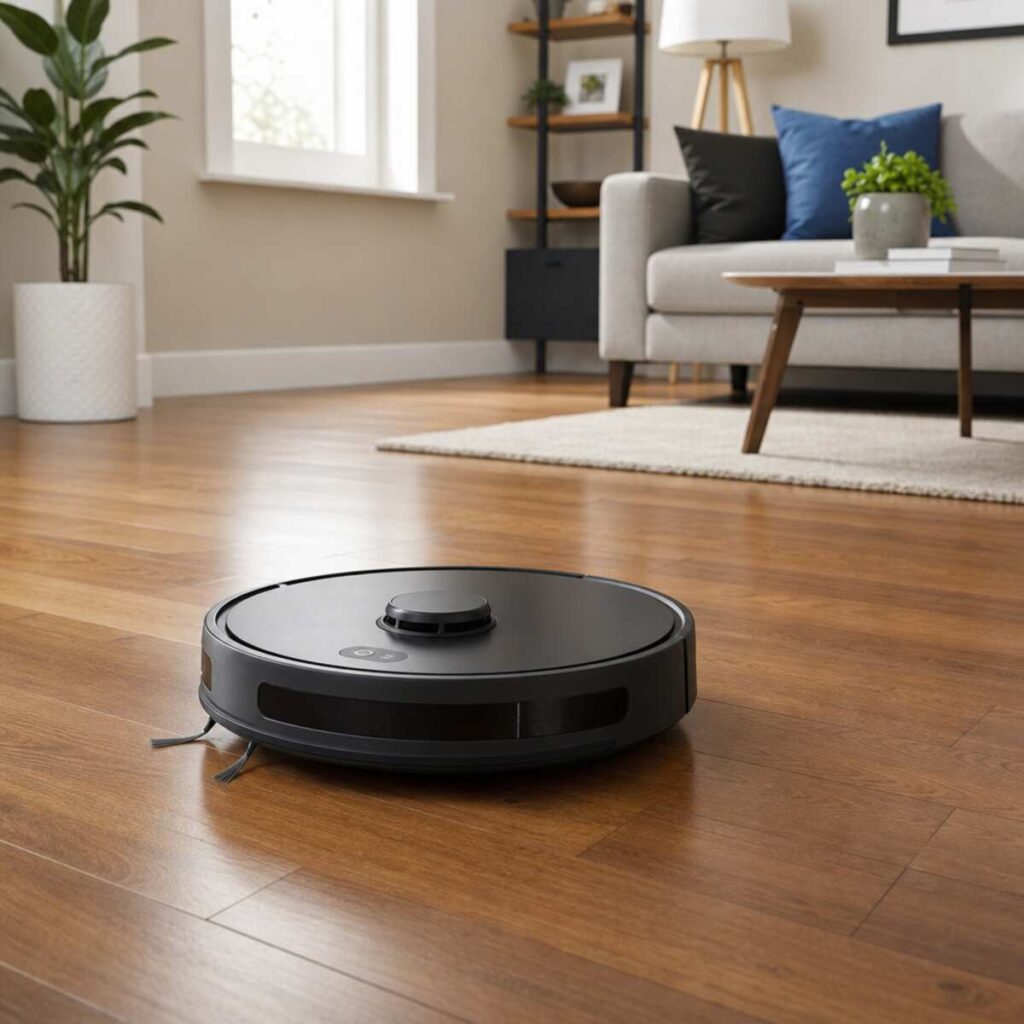
Picture this: you have just returned home after a long, exhausting day at work. Instead of being greeted by tumbleweeds of pet hair and a floor covered in everyday debris, you walk into a pristine home. The carpets are freshly groomed, the hard floors are immaculate, and the air feels distinctly clean. You didn’t lift a finger to achieve this. This is no longer a futuristic fantasy; it is the modern reality made possible by Robot Vacuums. Read the Best info about Robot Süpürge.
In the rapidly evolving landscape of home automation, few devices have made as significant an impact on our daily lives as autonomous floor cleaners. We have come a long way from dragging heavy, corded canisters around the house. Even as cordless vacuums revolutionized manual cleaning with their lightweight convenience, Robot Vacuums have taken it a step further by removing the human element from the equation almost entirely.
However, before you invest your hard-earned money into a robotic cleaning companion, it is crucial to understand what these machines can and cannot do. Are they a complete replacement for your traditional vacuum? Do they justify their price tags?
In this comprehensive guide, we will dive deep into the world of Robot Vacuums, exploring their immense advantages, their notable limitations, and the underlying technology that powers them. By the end of this article, you will have all the knowledge necessary to decide if a robotic vacuum is the right fit for your household.
The Undeniable Pros of Robot Vacuums
The surge in popularity of Robot Vacuums is not a mere trend; it is backed by a multitude of practical benefits that genuinely improve quality of life. Let us explore the core advantages that make these devices a staple in modern home automation.
Unmatched Convenience and Time-Saving Capabilities
The most glaring benefit of owning a robot vacuum is the gift of time. Vacuuming is a tedious, repetitive chore that can easily consume hours of your week. By offloading this task to an autonomous device, you reclaim that time for work, family, or relaxation. You can schedule the robot to clean while you are asleep, at the office, or running errands. The sheer convenience of setting a schedule and forgetting about it is the primary reason millions of households have adopted this technology.
Intelligent Navigation: LiDAR vs Camera-Based Navigation Systems
Early robot vacuums wandered aimlessly, but today’s models are equipped with brilliant digital brains. When evaluating high-end models, you will often find a debate between LiDAR vs camera-based navigation systems.
- LiDAR (Light Detection and Ranging): These systems use an invisible spinning laser on top of the vacuum to measure distances to walls and furniture, creating highly accurate, real-time 3D maps of your home. LiDAR works flawlessly in pitch-black darkness, making it perfect for nighttime cleaning.
- Camera-Based (vSLAM): These models use optical lenses to capture visual landmarks in your home to orient themselves. While they are incredibly smart and often allow for a lower-profile design (so the vacuum can fit under low furniture), they generally require ambient light to “see” where they are going.
Both systems have transformed the way Robot Vacuums move, ensuring they clean systematically rather than bumping blindly into your walls.
Advanced Mapping for Large Properties
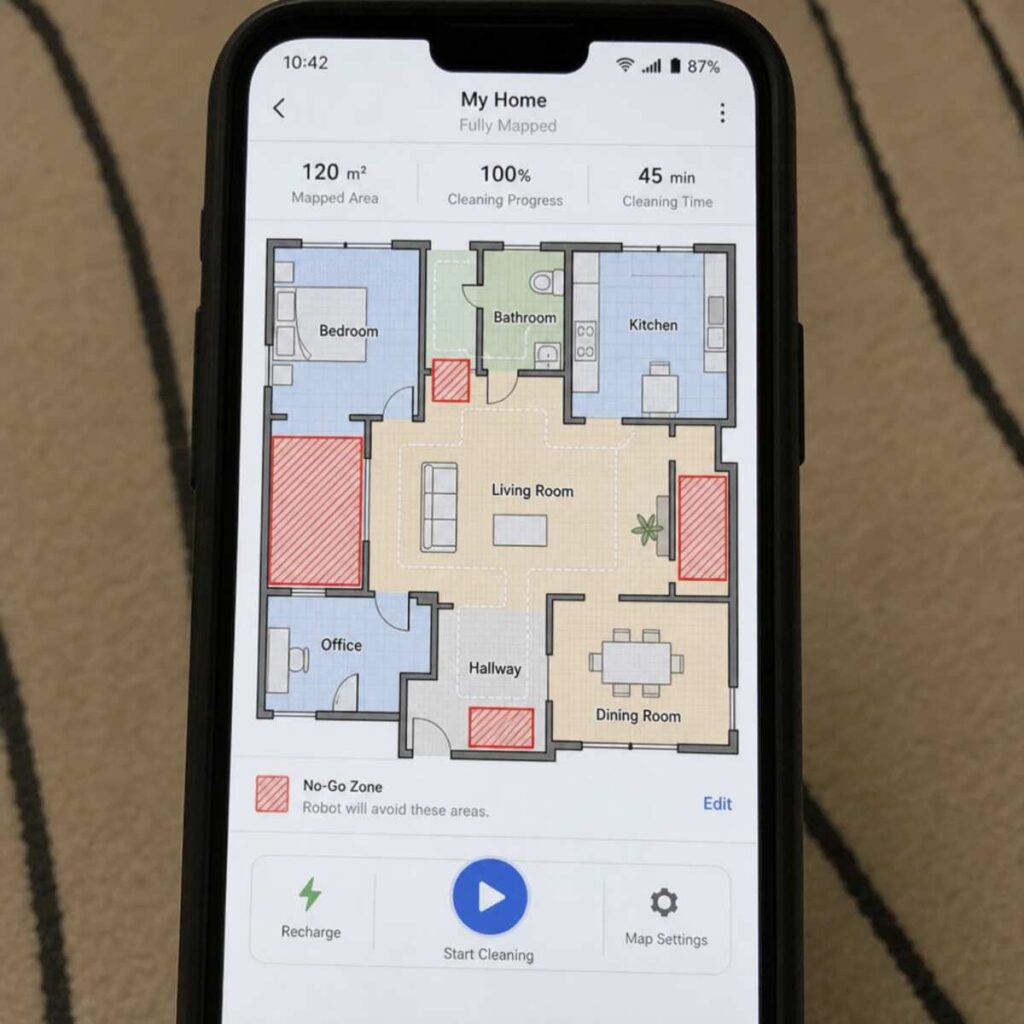
Gone are the days when a robot vacuum would get lost in a large house. Today, smart mapping technology for multi-level homes allows premium vacuums to save different floor plans in their memory. You can physically pick up the vacuum, carry it upstairs, and it will instantly recognize its new location and load the correct map.
Within these detailed digital maps—accessible via smartphone apps—you have complete control over your home’s layout. A major advantage here is programming virtual boundaries and no-go zones. Instead of putting down physical magnetic strips like in the old days, you simply draw a line on your phone screen to keep the vacuum away from delicate antique furniture, a messy child’s playroom, or the dog’s water bowl.
A Haven for Pet Owners
If you share your home with cats or dogs, you know the daily struggle of managing shedding fur. Modern robotic cleaners are specifically engineered with this in mind. The most effective automated cleaners for pet hair feature dual, tangle-free rubber brush rolls that lift fur from carpets without getting choked by long strands of hair.
Because you can schedule the robot to run every single day—or even twice a day—pet hair simply does not have the chance to accumulate into large, unmanageable tumbleweeds.
Breathe Easier: Air Quality and Filtration
Vacuuming isn’t just about removing visible dirt; it is about maintaining a healthy breathing environment indoors. High-quality Robot Vacuums are equipped with advanced HEPA filtration systems for dust mites, pollen, pet dander, and other microscopic allergens.
HEPA (High-Efficiency Particulate Air) filters trap up to 99.97% of particles as small as 0.3 microns. Because the robot is capturing these irritants daily and preventing them from being kicked up into the air as you walk, many allergy sufferers report a significant reduction in symptoms after introducing a robot vacuum into their home.
Uninterrupted Cleaning Stamina
If you live in a sprawling home, you might worry that a small battery-powered robot won’t finish the job. However, modern lithium-ion batteries provide exceptional runtimes, often exceeding 150 minutes on a single charge.
More importantly, the integration of battery life and recharge-and-resume capabilities ensures that the job always gets done. If the robot detects its battery running low before the cleaning cycle is complete, it will automatically navigate back to its dock, recharge just enough to finish the task, and then return to the exact spot it left off to resume cleaning.
Hands-Free Dirt Disposal
Perhaps the greatest innovation in the last five years of robotic cleaning is the auto-empty dock. The self-emptying base station benefits cannot be overstated. In traditional models, the small onboard dustbin requires manual emptying every day or two, which can be messy and exposes you to the dust you just cleaned up.
With a self-emptying base, the robot drives onto its dock, and a powerful secondary vacuum sucks the debris out of the robot and into a large, sealed, disposable bag inside the base station. These bags typically hold 30 to 60 days’ worth of dirt. This means you can legitimately go for weeks without ever touching the vacuum or worrying about dust plumes.
Seamless Smart Home Integration
For the tech-savvy homeowner, Robot Vacuums act as a natural extension of an interconnected ecosystem. Through voice command integration with smart hubs like Amazon Alexa, Google Assistant, or Apple HomeKit, cleaning becomes as easy as speaking a sentence.
Imagine spilling a box of cereal in the kitchen. Instead of retrieving a broom, you simply say, “Alexa, tell the vacuum to clean the kitchen.” The robot leaves its base, travels directly to the kitchen, cleans the mess, and returns to dock—all without you lifting a finger or opening an app.
The Cons and Limitations: What You Need to Know
Despite their incredible advancements, Robot Vacuums are not magic. They have physical and technological limitations that consumers must be aware of to set realistic expectations.
The Deep Carpet Challenge
While robot vacuums excel on hardwood, tile, and low-pile carpets, they face a formidable foe in thick, plush rugs. When looking at spec sheets, you will often see suction power specifications for high-pile carpets listed in Pascals (Pa).
While modern premium robots boast impressive ratings (sometimes exceeding 8,000 Pa), this is still less raw lifting power than a premium plug-in upright vacuum. High-pile carpets require deep agitation and massive airflow to pull embedded dirt from the base of the fibers. A robot vacuum will easily maintain the surface of thick rugs, keeping them looking fresh, but it cannot completely replace the deep-cleaning capabilities of a traditional vacuum for a heavily carpeted home.
The Clutter Conundrum
Robot vacuums require a relatively tidy floor to operate efficiently. A stray charging cable, an abandoned sock, or a rogue shoelace can quickly wrap around the main brush roll, bringing the machine to a dead stop and sending a distress notification to your phone.
While manufacturers have made massive leaps in advanced obstacle avoidance for household clutter—using AI-powered cameras to visually identify and bypass shoes, pet waste, and cords—no system is 100% foolproof. You still need to do a quick “pre-clean” sweep of the floor to pick up major hazards before the robot runs.
Noise Levels and Intrusiveness
Though generally quieter than traditional uprights, robot vacuums are not silent. Depending on the suction setting, the noise can be disruptive if you are trying to watch television, take a work-from-home conference call, or sleep.
When shopping, it is wise to review the decibel ratings for quiet operation modes. Many robots operate at around 60 to 65 decibels on standard settings, which is akin to a normal conversation. However, when they ramp up their suction to clean a carpet, or when the self-emptying base engages (which sounds like a jet engine for about 15 seconds), it can be quite loud. Fortunately, robust scheduling features allow you to run the robot when you are out of the house, mitigating this issue entirely.
The Mopping Dilemma
Many modern robot vacuums come as 2-in-1 combo units. However, the efficiency of hybrid mop and sweep combos varies wildly.
Entry-level hybrid robots simply drag a damp microfiber cloth across the floor behind them. While this is fine for wiping away superficial surface dust, it is entirely ineffective against dried, sticky spills—and in worst-case scenarios, it can end up smearing a mess across a larger area.
Premium models have addressed this by introducing sonic scrubbing technologies (vibrating the mop pad thousands of times a minute) or utilizing dual spinning mop pads. Some advanced base stations even wash the mop pads with hot water and dry them with hot air. However, these high-functioning hybrid systems come at a premium price point, and even the best robot mop cannot replicate the elbow grease a human applies to a stubborn stain.
The Mechanics: How Robot Vacuums Actually Work
To truly appreciate both the pros and cons, it helps to understand the fundamental mechanics driving these autonomous helpers.
Navigation Logic
If you ever watched an older robot vacuum ping-pong erratically across a room, you witnessed a random navigation algorithm. These older or budget models clean by driving in a straight line until they hit an obstacle, turning at a random angle, and continuing. Over a long enough time, they generally cover the whole room, but it is highly inefficient.
Today, the standard for mid-range to high-end models is systematic pathing versus random bounce patterns. Using their LiDAR or vSLAM mapping, the robot first outlines the perimeter of a room. Once the boundaries are established, it cleans the interior space using neat, overlapping S-shaped or Z-shaped rows. This guarantees that no spot is missed, vastly reduces cleaning time, and creates highly satisfying vacuum lines on your carpets.
The Anatomy of Cleaning
A robot vacuum doesn’t clean exactly like a traditional vacuum. It relies on a three-stage cleaning system:
- Side Brushes: One or two spinning brushes reach beyond the chassis to sweep dirt from corners and edges directly into the robot’s path.
- Main Agitator Brush: A central rolling brush (bristled, or preferably rubber) agitates the floor to lift stuck-on dirt and hair.
- Suction Motor: A highly efficient motor pulls the agitated dirt up into the dustbin and through the HEPA filter.
Maintenance Guide for Optimal Performance
A robot vacuum is an investment, and like any machine, it requires upkeep to function properly and protect your return on investment. Neglecting maintenance will lead to degraded performance, poor navigation, and eventually, hardware failure. Here is an overview of routine maintenance for autonomous cleaning devices.
Weekly Maintenance Tasks
Even with a self-emptying base, there are small tasks you should perform weekly to keep your robot humming:
- Wipe Down the Body: Dust accumulates on the top of the robot. Use a dry microfiber cloth to keep it looking pristine.
- Check the Wheels: Inspect the caster wheel at the front and the two main drive wheels. Remove any tangled hair or string that might impede their movement.
- Empty/Check the Dustbin: If you don’t have a self-emptying base, you must empty the onboard bin manually after every 1-2 runs. Even if you do have an auto-empty dock, check the onboard bin weekly to ensure nothing oversized is wedged inside blocking the exit port.
How to Maintain Sensors and Brushes
The sensors are the eyes of your robot, and the brushes are its hands. If they fail, the robot fails.
- Cleaning the Sensors: Around the perimeter and underneath the robot, you will find several small, dark windows. These are infrared cliff sensors (which stop the robot from tumbling down the stairs) and wall sensors. Take a clean, dry microfiber cloth and gently wipe these sensors every two weeks. If they become coated in dust, the robot may incorrectly think it is at the edge of a stair and refuse to move, throwing a “cliff sensor error.”
- Maintaining the Main Brush: Remove the main brush roll from its housing (usually done by pinching two release tabs). Even “tangle-free” brushes will occasionally wrap long human hairs around their axles. Use the small cleaning tool provided with the vacuum (which features a recessed blade) to slice through tangled hair and pull it away. Check the bearings on either end of the brush to ensure they spin freely.
- Side Brush Care: Side brushes often get bent or frayed. If they look worn, unscrew or pop them off and clean underneath them. If the bristles are severely bent, soaking them in hot water for a few minutes can often straighten them out; otherwise, it is time to replace them.
Monthly and Bi-Annual Maintenance
- Filter Care: Tap the HEPA filter against the side of a trash can to dislodge fine dust. Do not wash HEPA filters with water unless the manufacturer specifically states they are washable, as water can destroy the microscopic paper fibers. Replace the filter entirely every 3 to 6 months.
- Base Station Care: If you have a self-emptying base, check the pathway from the floor to the bag for clogs. If you have a mop-washing base station, you must regularly clean the dirty water tank and scrub the washboard tray where the robot cleans its mops to prevent foul odors and mold.
Actionable Tips for Choosing Your Perfect Robot Vacuum
With so many models on the market, ranging from $150 to over $1,500, selecting the right one can feel overwhelming. Use these actionable tips to align the features with your specific needs:
- Assess Your Floor Plan: If you live in a small, single-story apartment with primarily hard floors, a budget-friendly model with basic navigation might be all you need. If you live in a sprawling, multi-level 4,000-square-foot house, you absolutely need a premium model with LiDAR mapping, recharge-and-resume capabilities, and multi-floor memory.
- Evaluate Your Pet Situation: If you have heavily shedding pets, do not compromise on the brush type. Look exclusively for robots with dual rubber brush rolls rather than traditional bristles. Rubber rollers are vastly superior at pulling up pet hair without getting tangled. Additionally, a self-emptying base is non-negotiable for pet owners, as a small onboard bin will fill up with fur in less than ten minutes.
- Consider Your Clutter Habits: Be honest with yourself about your home’s tidiness. If you have children who leave toys everywhere, or if your floors are constantly littered with clothes and cords, you must invest in a robot with advanced AI obstacle avoidance. A basic LiDAR robot will just bulldoze through your kids’ legos and get stuck on a shoelace.
- Prioritize Allergy Needs: If anyone in the household suffers from asthma or allergies, prioritize machines boasting true HEPA filtration and ensure you utilize a self-emptying base so you are never exposed to the dust plume during disposal.
- Skip the Mop if You Have Mostly Carpets: If your home is 80% carpet, do not pay extra for a hybrid mop-and-sweep combo. The mopping feature will go unused, and you are better off allocating that budget toward a robot with higher suction power or a better auto-empty base. Conversely, if your home is predominantly tile or hardwood, a premium vibrating or spinning hybrid mop combo is a game-changer.
The Verdict: Are Robot Vacuums Worth It?
When looking comprehensively at the pros and cons, the verdict is incredibly clear: Robot Vacuums are absolutely worth the investment for the vast majority of households.
They represent the pinnacle of accessible home automation. By understanding the suction power specifications for high-pile carpets and acknowledging that they are meant to maintain cleanliness rather than provide deep, restorative carpet extraction, you can set the right expectations. They are not designed to completely replace traditional cordless vacuums for deep spring cleaning, cleaning stairs, or dusting upholstery.
Instead, Robot Vacuums serve as the ultimate daily maintenance tool. They operate tirelessly in the background, leveraging smart mapping technology, advanced obstacle avoidance, and self-emptying base stations to ensure that your home’s baseline level of cleanliness is remarkably high, day in and day out.
By following proper routine maintenance for autonomous cleaning devices and utilizing features like virtual no-go zones and voice command integrations, you transform a tedious chore into a seamless, automated background process. Ultimately, a robot vacuum doesn’t just buy you cleaner floors—it buys you back your time, and that is a luxury worth paying for.