


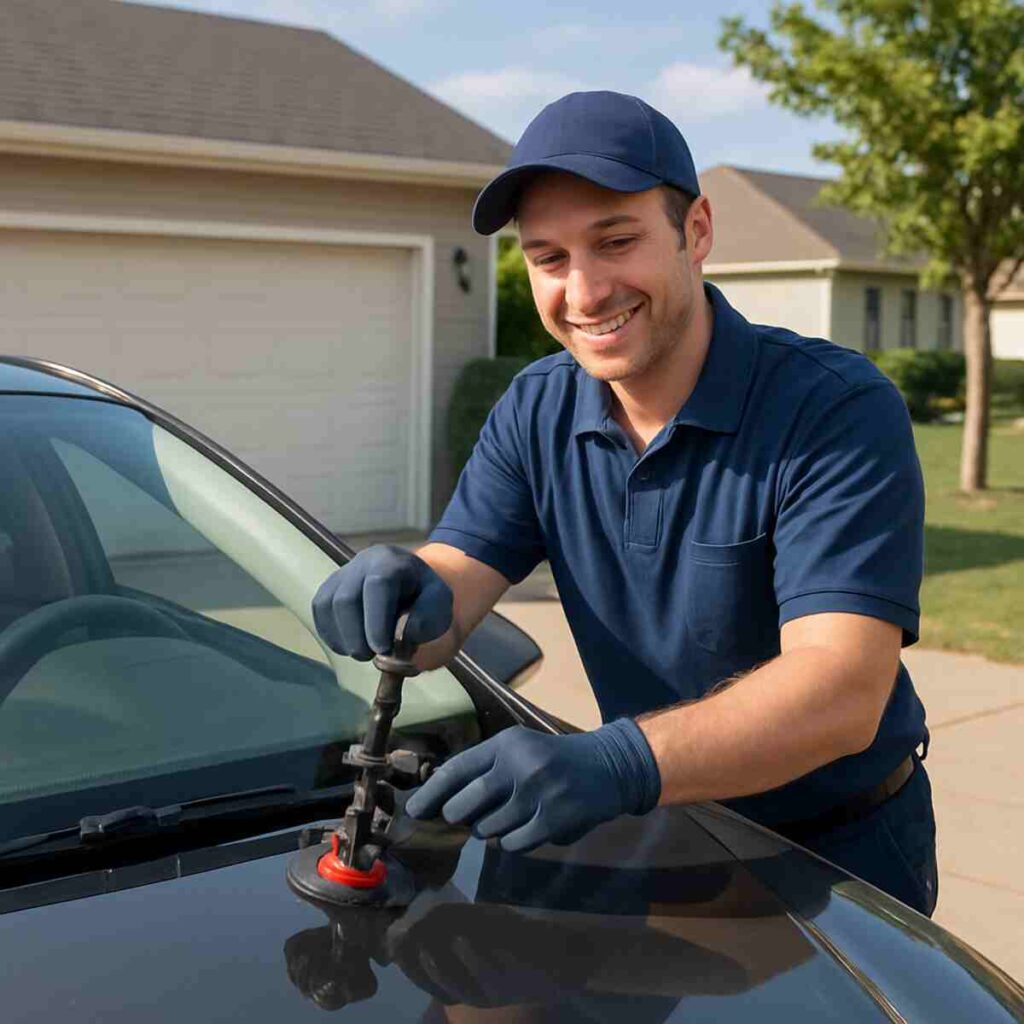
It’s a sound every driver dreads: the sharp thwack of a rock hitting the windshield on the highway. Your heart sinks as you scan the glass and spot the new blemish—a tiny starburst or chip right in your field of view. The immediate thought is often a mix of frustration and worry about the time, cost, and hassle involved in getting it fixed. Receive the Best information about mobile auto glass repair.
For many, this is where the mental gymnastics begin. Do I need to take a day off work? Can I even find a reputable shop nearby? The thought of rearranging your schedule to drive somewhere, wait in a lobby, and arrange for a ride back can be enough to make you put the repair off, hoping that small chip doesn’t get any worse. But ignoring it is a gamble, as a small chip can easily turn into a large crack with the next bump in the road or change in temperature.
What if the solution was simpler and more convenient than you ever imagined? Enter mobile auto glass repair, a service designed for the realities of a busy life. Instead of you going to the shop, a certified technician comes directly to your home, your office, or wherever you happen to be. This modern approach transforms a day-long headache into a quick, seamless fix that happens on your schedule, often in less than an hour.
Beyond just convenience, choosing a prompt windshield repair can save you significant money and keep your vehicle safer. As industry experts will tell you, the windshield provides up to 30% of a vehicle’s structural strength in a rollover accident. Repairing a chip restores that integrity, preventing the need for a full, and much more expensive, car glass replacement down the line. It’s a small fix that makes a big difference.
To make a smart, confident decision, it helps to understand a few key areas, from repair options and service procedures to insurance coverage and the critical safety systems involved.
Key topics covered:
- Repair vs. Replace: A simple rule to know which you need.
- How Mobile Service Works: What to expect when the technician arrives.
- Insurance and Costs: Answering the question: “Is this really free?”
- The ADAS Safety Check: A critical, must-know detail for modern cars.
- Choosing a Pro: How to spot a reputable and reliable service.
Repair or Replace? The Simple ‘Dollar Bill Rule’ for Your Windshield
That fresh chip on your windshield leaves you with a critical question: can it be fixed, or are you on the hook for a full replacement? Before you assume the worst, there’s an easy guideline you can use right now. It’s called the “Dollar Bill Rule,” and it’s the go-to reference for professional technicians. Simply hold a dollar bill up to the damage. If the chip or crack is completely covered by the bill, it can almost certainly be repaired.
This simple guideline works because a windshield repair involves injecting a special resin that fills the damaged area, hardens, and restores the glass’s original strength. For smaller blemishes, this process is incredibly effective. However, when damage is too large, the resin can’t properly bond, and the windshield’s structural safety is compromised. That’s why fixing a chip in windshield while it’s still small is the best way to avoid a more expensive problem.
Beyond size, the location of the damage is just as critical for safety. Even a tiny chip requires a full replacement if it’s in one of these three “no-go” zones:
- Directly in the driver’s line of sight. A repair can leave a minor distortion, and you don’t want anything obstructing your view of the road.
- On the very edge of the windshield. Damage here can weaken the entire structure of the glass, making a simple repair unsafe.
- A crack that has already started to spread. Once a crack begins to run, its stability is gone, and a full replacement is the only safe option.
Ultimately, time is not on your side. A small, easily repairable chip is an unstable problem waiting to happen. A bump in the road, a change in temperature from an air conditioner or defroster, or even just daily driving stress can cause it to spread into a long crack overnight. What starts as a quick and affordable cracked car window repair can quickly become a costly and time-consuming replacement.
How a ‘Come to You Car Glass Service’ Reclaims Your Day
Now that you know a small chip needs quick attention, the next thought is often, “How will I find the time to get this fixed?” This is where the modern solution of a come to you car glass service completely changes the game. Instead of you rearranging your schedule to drive to a shop, wait in a lobby, and then drive back, a certified technician comes directly to your location. This simple shift turns a multi-hour hassle into a minor background event in your day.
The process itself is designed to be completely unobtrusive. It typically starts with a quick phone call or by filling out a simple online form to schedule your appointment. On the service day, a technician arrives in a van equipped with all the necessary tools and materials. Whether you’re at home or need a same-day auto glass service at work, they can perform the repair right in your driveway or office parking lot. You don’t have to hand over your keys or stop what you’re doing; the work is done while you continue with your life.
Beyond the convenience of location, the time savings are significant. A standard mobile auto glass repair for a chip is often completed in under 30 minutes. When you factor in the eliminated travel and wait times, you’re reclaiming hours of your valuable time. This efficiency and flexibility mean you can address windshield damage immediately, securing your vehicle’s safety without disrupting your work or family commitments. But with such a convenient service, what about the cost?
Is Mobile Glass Repair Covered by Insurance? Decoding the Costs
The big question on every driver’s mind when they see a new chip is, “How much will this cost?” The answer, thankfully, is often much less than you think. While the final price depends on your specific insurance policy, there’s a strong financial reason to act quickly, especially for small repairs. Many people wonder, is mobile glass repair covered by insurance, and the answer is frequently a surprising and welcome “yes.”
This surprising benefit comes down to a part of your auto policy called comprehensive insurance. This is the coverage that handles damage not caused by a collision, like theft, hail, or a rock hitting your windshield. Because a small repair is far more affordable than a full replacement down the road, most insurance companies actively encourage it. To do so, they will often waive your comprehensive insurance deductible—the amount you typically pay out-of-pocket on a claim—if you choose to repair the chip instead of letting it spread.
To see how this plays out for your wallet, let’s look at the most common cost scenarios. Finding a service for glass repair near me is one thing, but understanding the final bill is another.
- Chip Repair with Comprehensive Insurance: In most cases, this costs you $0 out-of-pocket. Your insurer covers the entire bill without you needing to pay a deductible.
- Windshield Replacement with Comprehensive Insurance: You are responsible for paying your deductible. The typical on-site windshield replacement cost for you would be whatever your deductible is set at, whether it’s $250, $500, or more.
- No Comprehensive Insurance: You pay the full cost for the service. This highlights the value of repair, which might be around $100, versus a replacement that can easily run from $400 to over $1,500 on modern vehicles.
Finally, there’s the lingering worry: will making a glass claim raise my insurance rates? For most drivers, the answer is no. Insurers generally view windshield damage as a no-fault glass claim, meaning it wasn’t caused by your driving habits. It’s treated differently from an at-fault collision, so a repair or replacement is highly unlikely to impact your premium. This gives you the peace of mind to fix the problem without fearing a penalty.
How Long Does It Take to Replace a Windshield at Home? A Realistic Timeline
When you schedule a mobile service, one of your first questions is likely about time. The answer to how long does it take to replace a windshield at home depends entirely on whether you need a quick repair or a full replacement. A simple chip repair is incredibly fast; a technician can often have it filled, cured, and finished in under 30 minutes, making it an easy fix to fit into a lunch break. You can drive the car immediately after the work is done.
For a full windshield replacement, however, the process is more involved than just swapping out the glass. After the technician carefully removes the old windshield and prepares the frame, they apply a powerful adhesive called urethane to create a waterproof, structural bond. This isn’t like simple glue; it’s an industrial-grade sealant that is critical to your car’s safety. The actual hands-on work usually takes about 60 to 90 minutes. But the most important part of the timeline happens after the new glass is in place.
This crucial waiting period is known as the Safe Drive-Away Time (SDAT). It’s the minimum time required for the urethane to harden, or cure, enough to perform its vital safety functions. Why is this so important? In a collision, your passenger-side airbag deploys upwards and uses the windshield as a backstop. If the adhesive isn’t fully cured, the windshield could pop out, rendering the airbag ineffective. A properly bonded windshield also provides up to 60% of the roof’s structural strength in a rollover accident. Rushing the auto glass resin curing time is a dangerous shortcut that a reputable emergency car window service will never take.
So, while the technician might only be working for about an hour, you should plan for your car to remain parked for at least another hour or two afterward. A safe total is typically around three hours from arrival to the moment you can confidently get back on the road. But the clock doesn’t stop there for many modern cars. Once the new glass is securely in place, there’s another critical safety step related to your car’s advanced features that can’t be overlooked.
Why Your Car’s ‘Eyes’ Need Recalibrating: The Hidden Safety Step After Replacement
That final, critical safety step we mentioned involves your car’s modern “eyes.” If your vehicle was made in the last several years, it likely has a small camera mounted near the rearview mirror. This camera is the key to your car’s Advanced Driver-Assistance Systems, or ADAS—the clever features that act like a helpful co-pilot, designed to prevent accidents before they happen.
When a technician replaces your windshield, the camera is detached from the old glass and mounted onto the new one. This process, no matter how carefully done, can shift the camera’s viewing angle by a tiny, almost imperceptible amount. But on the road, a one-millimeter difference at the windshield can translate to a miscalculation of several feet 50 yards away. This could mean the difference between your car braking safely or failing to react in time. Recalibration is the essential process of re-aiming that camera to factory specifications, ensuring it “sees” the road exactly as it was designed to.
Not sure if your car has these features? You probably do if it has any of the following systems that rely on that forward-facing camera:
- Lane-Keeping Assist (nudges you back into your lane)
- Automatic Emergency Braking
- Adaptive Cruise Control (maintains a set distance from the car ahead)
- Collision Warning
A certified technician will perform one of two types of recalibration. Static recalibration is done while the car is parked, using special targets placed at precise distances. Dynamic recalibration involves driving the car on well-marked roads to let the system adjust itself. A professional with the right technician certification will know exactly which procedure your vehicle’s manufacturer requires. While many providers can perform a mobile ADAS recalibration service for convenience, some vehicles require the controlled environment of a shop, a key factor in the mobile vs in-shop auto glass replacement decision.
Ultimately, skipping recalibration is like getting new prescription glasses but never checking if the lenses are correct—it defeats the entire purpose. When you get a quote for a windshield replacement, you should always ask: “Does this price include the necessary ADAS recalibration?” Reputable companies will always include it as a non-negotiable part of the safety process.
OEM vs. Aftermarket Glass: Does the Brand of Your Windshield Really Matter?
When it comes to a car glass replacement, the short answer is yes, the brand and quality of the glass matter—but maybe not in the way you think. You’ll typically hear two terms when discussing your options: OEM and aftermarket. Understanding the difference is key to making a smart, safe decision that fits your budget. OEM stands for Original Equipment Manufacturer. This is glass made by the same company that produced the original windshield for your vehicle, and it will be identical in every way, right down to the carmaker’s logo printed on it.
On the other side, you have aftermarket glass, which is sometimes called OEE (Original Equipment Equivalent). Think of this like choosing a generic-brand medicine over a name brand at the pharmacy. Aftermarket glass is produced by companies that are not the original supplier to your carmaker, but they manufacture glass designed to fit and function just like the original. Because these manufacturers don’t have the same branding agreements, their products often have a lower on-site windshield replacement cost, which can mean significant savings for you.
This is where the most important question comes up: is it safe? Reputable aftermarket glass is far from a cheap knock-off. In the United States, all auto glass sold must meet strict safety standards set by the Department of Transportation (DOT). This ensures it has the same strength and shatter-resistance as the original. The primary difference often comes down to a perfect fit. While high-quality aftermarket glass (OEE) is engineered to match the original’s specifications precisely, lower-tier options can sometimes have minor variations in shape or clarity.
Ultimately, the debate over OEM vs OEE auto glass quality often misses the most crucial factor: the skill of the person installing it. The most expensive, high-tech piece of glass is only as good as the seal holding it in place. A top-tier aftermarket windshield installed by a certified professional is a safer choice than an OEM windshield installed poorly. This is why your focus should be on finding a trustworthy provider. That way, you can have a confident conversation about which glass option provides the best balance of safety and value for your specific vehicle.
How to Spot a Pro: Why Technician Certification is Your Shield Against a Bad Fix
Finding a skilled installer is more important than the brand of glass you choose, but how can you tell an expert from an amateur before they start working on your car? Unlike licensed electricians or plumbers, the auto glass repair field isn’t consistently regulated. This means that nearly anyone can buy the tools and claim to be a professional, putting your safety at risk. A faulty installation can lead to water leaks and wind noise, but more dangerously, it can compromise your vehicle’s structural integrity and the function of your airbags in an accident.
This is where independent certification becomes your best defense. The most important credential to look for is certification from the Auto Glass Safety Council (AGSC). Think of the AGSC as a non-profit safety watchdog for the industry. Technicians who are AGSC-certified have passed an exam and have pledged to follow the Auto Glass Replacement Safety Standard (AGRSS). This standard is essentially the master playbook for safe windshield replacement, detailing everything from using the correct adhesive to waiting the proper amount of time for it to cure before you can safely drive.
Armed with this knowledge, you can vet any company in minutes. Before you schedule a mobile auto glass repair, use this simple checklist to ensure you’re hiring a true professional.
Your Pre-Booking Checklist:
- “Are your technicians certified by the Auto Glass Safety Council (AGSC)?”
- “Do you follow the Auto Glass Replacement Safety Standard (AGRSS)?”
- “Do you provide a written warranty for your work and parts?”
A confident “yes” to these three questions is the clearest sign that a company is committed to your safety. Once you’ve found a trustworthy provider, the final step is knowing what other factors, like weather, might affect your appointment.
Can a Cracked Windshield Be Repaired in the Rain? Your Mobile Service Questions Answered
You’ve scheduled your convenient mobile service, but now the forecast calls for showers. So, can a cracked windshield be repaired in the rain? The short answer is no, not if the car is exposed to the elements. For a safe, permanent bond, the specialized resins and adhesives used in glass repair and replacement must be applied to a completely clean and dry surface. Any moisture, whether from rain, snow, or even heavy dew, can compromise the seal, potentially leading to leaks or a failed repair down the line. However, this doesn’t automatically mean a cancellation. If you have a garage, carport, or access to a covered parking deck, the technician can perform the work without a problem.
Beyond just precipitation, temperature also plays a critical role. The advanced urethane used to secure a new windshield, for instance, is designed to cure properly within a specific temperature range, typically above freezing. In extreme cold, the adhesive can become too thick to apply correctly, and the glass itself can become more brittle. A professional come to you car glass service will always prioritize safety over speed; your technician will monitor the weather and will be the first to recommend rescheduling if conditions are not safe for a successful, lasting installation.
Knowing how to prepare for a mobile windshield installation can help make the appointment go even more smoothly. Before the technician arrives, it’s a good idea to clear your dashboard of any items like phone holders, toll passes, or decorative items to give them easy, unobstructed access to the glass. It’s also helpful to park your vehicle in a spot where the technician has enough room to open the car doors and move around freely.
On the day of the service, your role is simple. You’ll just need to meet the technician to provide the car keys and confirm the scope of the work. You don’t have to watch over their shoulder—feel free to go back to your work or relax at home while they handle the job. Once the installation is complete, the technician will let you know the “safe drive-away time,” which is the critical waiting period required for the adhesive to become strong enough for you to get back on the road.
Your Action Plan for a Safe and Convenient Windshield Service
That startling thwack of a rock against your windshield no longer has to be a moment of panic. Where you once saw a costly, time-consuming problem with an unknown solution, you can now see a clear path forward. You understand when a simple windshield repair is possible, why mobile auto glass repair offers a convenient fix, and what critical safety questions to ask to protect your family. You’ve traded uncertainty for competence.
Putting that knowledge into action is simple. The next time you find damage on your glass, don’t guess or worry. Just follow this straightforward checklist to manage the process with confidence.
Your 4-Step Action Plan
- Assess the Damage: Use the “Dollar Bill Rule.” If the chip or crack is smaller than a dollar bill, a repair is likely an option.
- Check Your Insurance: Call your provider to confirm your comprehensive coverage for glass repair vs. replacement and ask about your deductible.
- Find a Certified Pro: Search for local mobile services and ask if their technicians are AGSC (Auto Glass Safety Council) certified.
- Ask About ADAS: If getting a replacement, you must confirm that the provider performs on-site ADAS recalibration to ensure your car’s safety features work correctly.
That chip is no longer a day-ruining disaster; it’s an item on a to-do list you know exactly how to complete. By focusing on a certified technician and ensuring your safety systems are intact, you can be sure the job is done right. You’re now equipped to handle a broken windshield not with stress, but with a clear, safe, and efficient plan.